Demo
DEMO2026-04-28-p002
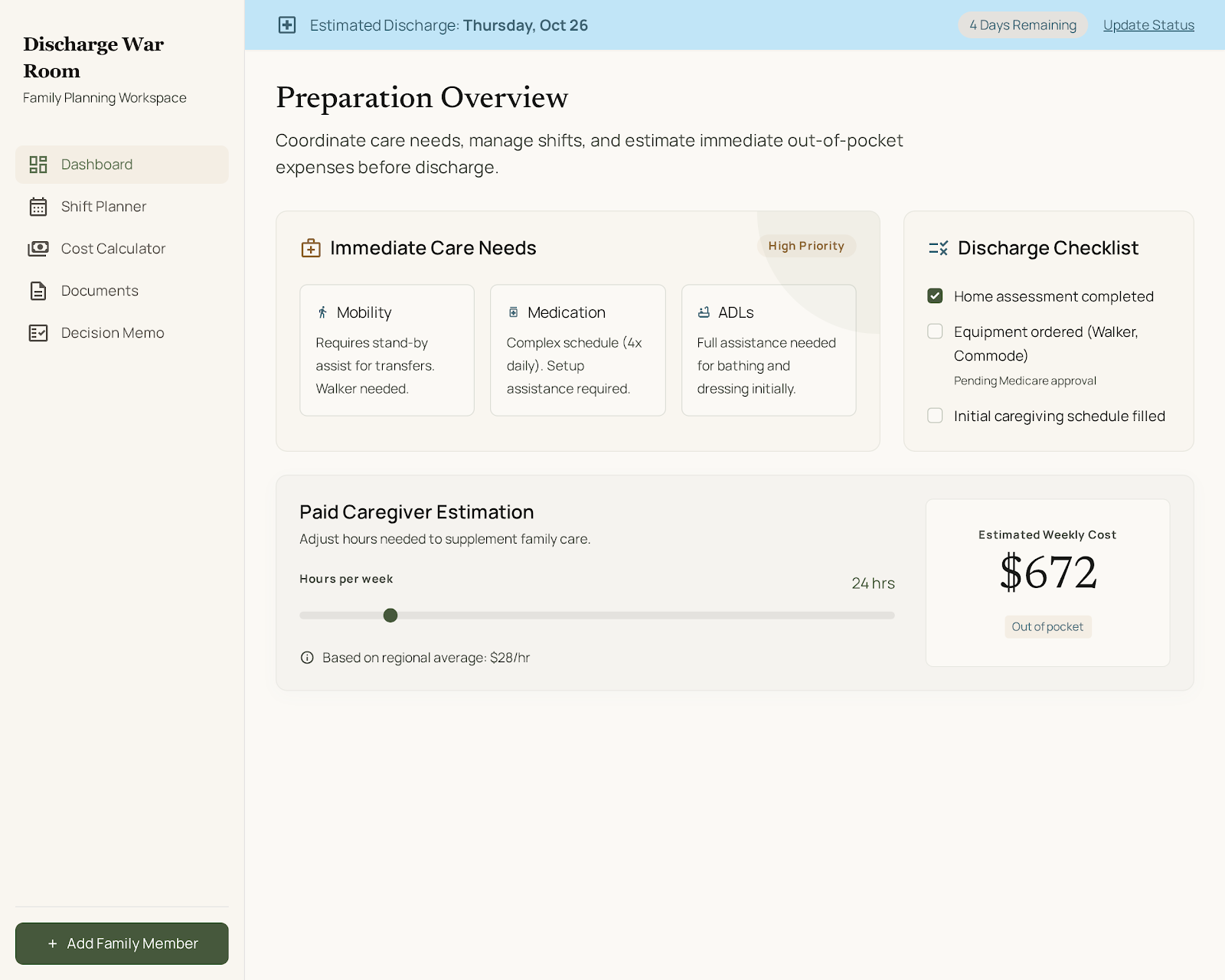
Discharge Care Cost War Room
A family care-planning board that turns hospital discharge panic into a realistic caregiver schedule, subsidy checklist, and weekly cost plan.
Build Notes
demostitchvanilla-html
Spec Notes
assumptions.md
# Assumptions (KNOWN / ASSUMPTION / UNKNOWN) — Discharge Care Cost War Room

## KNOWN
- Assigned slot: p002
- Theme: 건강
- Design profile: calm-consumer
- Evidence references:
- Google News RSS/조선일보 Korean care access signal: https://news.google.com/rss/search?q=Korea%20caregiver%20cost%20hospital%20discharge%20elder%20care%20family%20burden
- Google News RSS/HHS aging-services technology signal: https://news.google.com/rss/search?q=Korea%20caregiver%20cost%20hospital%20discharge%20elder%20care%20family%20burden

## ASSUMPTION
- The target user has enough urgency to try a lightweight decision workspace.
- A single-screen Stitch demo can communicate the value faster than a full app.
- The required sections are enough to make the prototype feel specific rather than generic.

## UNKNOWN
- Exact willingness-to-pay.
- Which data import path users would trust first.
- Whether users prefer automation or a manual checklist for the first version.
falsification.md
# Falsification checklist — Discharge Care Cost War Room

1. Does the prototype show a specific trigger/data source that differs from recent PF batches?
2. Can the target user identify themselves from the first screen copy?
3. Are the external/community signal references visible in the spec and meta.json?
4. Does the UI concept avoid generic dashboard/rescue/planner renaming?
5. Is the assigned design profile (calm-consumer) reflected in the Stitch prompt direction?
6. Does the key action produce a clear next decision, not just information display?
7. Would a user plausibly share or pay for this if the triggering pain happened today?
prd.md
# PRD — Discharge Care Cost War Room

## Candidate type
- Practical / Commercial

## Theme
- 건강

## Design profile
- calm-consumer

## Problem
- A family care-planning board that turns hospital discharge panic into a realistic caregiver schedule, subsidy checklist, and weekly cost plan.

## Target user
- Korean adult children coordinating care for an elderly parent after hospitalization while siblings argue over money, time, and paid caregiver options.

## Key UX
- Start from a discharge date and care needs, then compare family shifts, paid caregiver hours, documents, subsidy/insurance tasks, and weekly cash burn in one calm command center.

## Required UI sections
- discharge countdown strip
- care-needs severity cards
- family shift planner
- paid caregiver cost slider
- subsidy/document checklist
- sibling decision memo drawer

## External/community signal references
- Google News RSS/조선일보 Korean care access signal: https://news.google.com/rss/search?q=Korea%20caregiver%20cost%20hospital%20discharge%20elder%20care%20family%20burden
- Google News RSS/HHS aging-services technology signal: https://news.google.com/rss/search?q=Korea%20caregiver%20cost%20hospital%20discharge%20elder%20care%20family%20burden

## Stitch prompt
Design a desktop family eldercare planning workspace called Discharge Care Cost War Room for Korean adult children preparing for an elderly parent's hospital discharge. It should turn panic into a practical plan by comparing care needs, family shifts, paid caregiver hours, subsidy and document tasks, and weekly cash burn. Include a discharge countdown strip, care-needs severity cards, family shift planner, paid caregiver cost slider, subsidy/document checklist, and sibling decision memo drawer. Design direction: use a calm-consumer aesthetic with soft warm neutrals, reassuring hierarchy, gentle progress states, plain-language guidance, and low-alarm cost cues so the product feels humane, trustworthy, and steady during a family health crisis.

## Constraints
- Phase A only: spec/scaffold, no custom demo implementation.
- Preserve the assigned design profile in Stitch output.
- Use external signals as problem evidence, not market-size proof.

## Non-goals
- No external LLM API calls.
- No production backend.
- No payment flow implementation in Phase A.

## Success metrics
- A user can understand the core pain and next action within 10 seconds.
- The main UI exposes all required sections without placeholder text.
- Stitch output can be dropped into `/home/sy/Downloads/stitch_drop/2026-04-28/p002/`.
qa-checklist.md
# QA checklist — Discharge Care Cost War Room

## Phase A scaffold checks
- meta.json includes `theme`, `designProfile`, `externalSignals`, and `stitchPrompt`.
- spec/prd.md contains the one-liner, target user, key UX, UI sections, signal references, and full Stitch prompt.
- Slot folder exists under `prototypes/2026-04-28-p002-discharge-care-cost-war-room`.

## Stitch intake checks for 06:30 job
- Expected drop folder: `/home/sy/Downloads/stitch_drop/2026-04-28/p002/`
- Required files from user: `code.html` and `screen.png`.
- Ingest should preserve the original Stitch environment as the main demo experience.

## Acceptance verification
- Today has all slots p001 through p004.
- `node scripts/build-index.mjs` passes after scaffolding.
- No placeholder-only spec files remain for this idea.