Demo
DEMO2026-04-28-p001
AI Spend Seatbelt
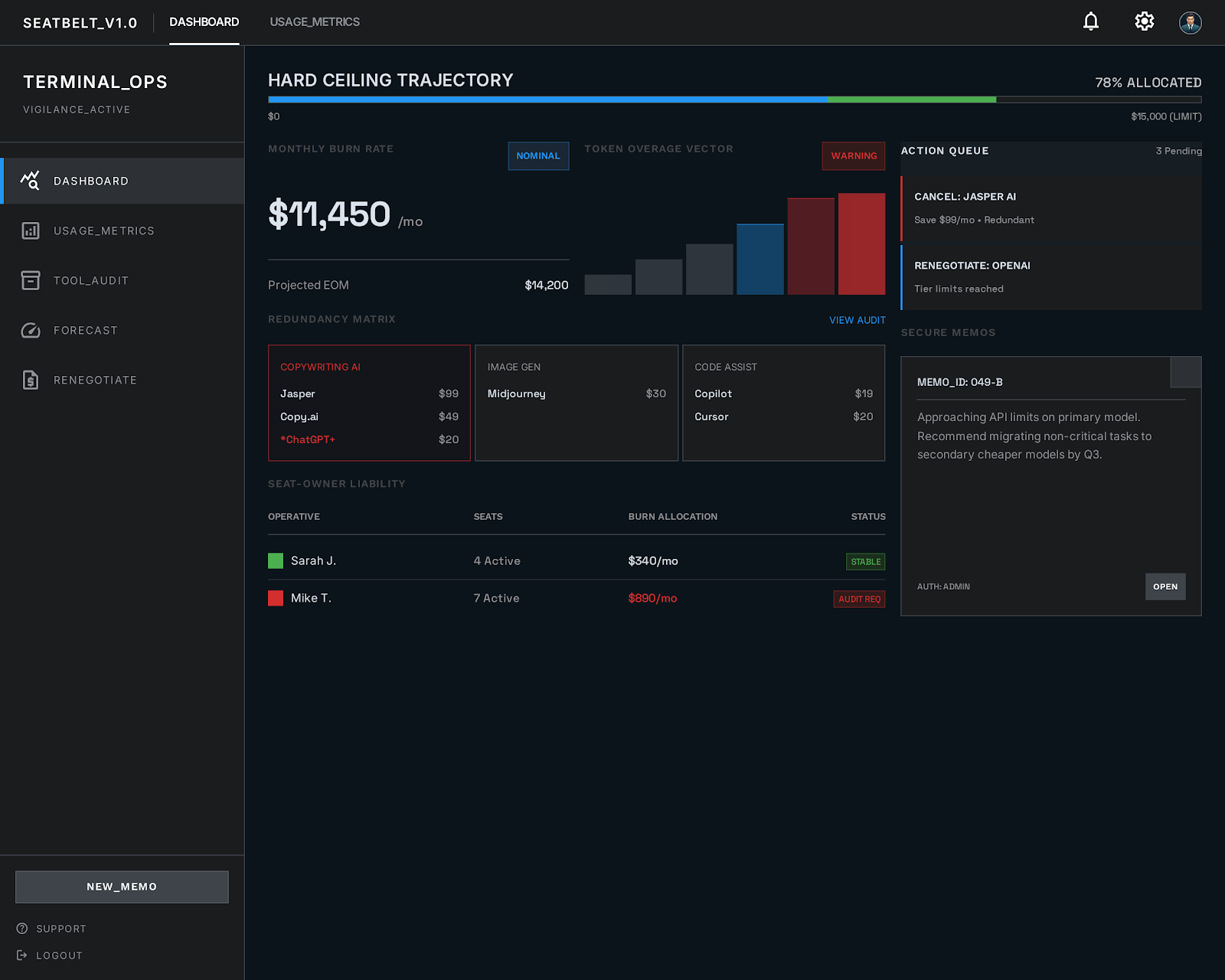
A usage-based AI and SaaS cost console that catches quiet subscription creep, token overages, and duplicate tools before small teams discover the bill too late.
Build Notes
demostitchvanilla-html
Spec Notes
assumptions.md
# Assumptions (KNOWN / ASSUMPTION / UNKNOWN) — AI Spend Seatbelt

## KNOWN
- Assigned slot: p001
- Theme: 자산 방어
- Design profile: financial-analyst
- Evidence references:
- Reddit r/freelance subscription-fatigue post: https://www.reddit.com/r/freelance/comments/1pc8tb0/does_anyone_know_good_software_for_creating/
- Google News RSS/PYMNTS AI pricing signal: https://news.google.com/rss/search?q=SaaS%20spend%20management%20AI%20subscription%20costs%20small%20business%202026

## ASSUMPTION
- The target user has enough urgency to try a lightweight decision workspace.
- A single-screen Stitch demo can communicate the value faster than a full app.
- The required sections are enough to make the prototype feel specific rather than generic.

## UNKNOWN
- Exact willingness-to-pay.
- Which data import path users would trust first.
- Whether users prefer automation or a manual checklist for the first version.
falsification.md
# Falsification checklist — AI Spend Seatbelt

1. Does the prototype show a specific trigger/data source that differs from recent PF batches?
2. Can the target user identify themselves from the first screen copy?
3. Are the external/community signal references visible in the spec and meta.json?
4. Does the UI concept avoid generic dashboard/rescue/planner renaming?
5. Is the assigned design profile (financial-analyst) reflected in the Stitch prompt direction?
6. Does the key action produce a clear next decision, not just information display?
7. Would a user plausibly share or pay for this if the triggering pain happened today?
prd.md
# PRD — AI Spend Seatbelt

## Candidate type
- Practical / Commercial

## Theme
- 자산 방어

## Design profile
- financial-analyst

## Problem
- A usage-based AI and SaaS cost console that catches quiet subscription creep, token overages, and duplicate tools before small teams discover the bill too late.

## Target user
- Freelancers, agency owners, and tiny teams now paying for multiple AI/SaaS tools without a finance department.

## Key UX
- Connect or paste monthly tool bills, group tools by job-to-be-done, flag token/seat overage risk, then issue one keep/cancel/renegotiate command list.

## Required UI sections
- monthly AI burn meter
- duplicate tool cluster map
- token overage forecast
- seat-owner accountability table
- cancel/renegotiate queue
- finance-safe memo drawer

## External/community signal references
- Reddit r/freelance subscription-fatigue post: https://www.reddit.com/r/freelance/comments/1pc8tb0/does_anyone_know_good_software_for_creating/
- Google News RSS/PYMNTS AI pricing signal: https://news.google.com/rss/search?q=SaaS%20spend%20management%20AI%20subscription%20costs%20small%20business%202026

## Stitch prompt
Design a desktop AI/SaaS cost-control workspace called AI Spend Seatbelt for freelancers, agency owners, and tiny teams that need to stop quiet subscription creep, token overages, and duplicate tools before the monthly bill lands. It should let users paste or connect tool bills, group products by job-to-be-done, forecast token and seat overages, and produce a keep/cancel/renegotiate command list. Include a monthly AI burn meter, duplicate tool cluster map, token overage forecast, seat-owner accountability table, cancel/renegotiate queue, and finance-safe memo drawer. Design direction: use a financial-analyst aesthetic with precise cost tables, navy graphite panels, disciplined variance badges, restrained warning red, and crisp budget math so the product feels like a serious asset-defense cockpit for small operators.

## Constraints
- Phase A only: spec/scaffold, no custom demo implementation.
- Preserve the assigned design profile in Stitch output.
- Use external signals as problem evidence, not market-size proof.

## Non-goals
- No external LLM API calls.
- No production backend.
- No payment flow implementation in Phase A.

## Success metrics
- A user can understand the core pain and next action within 10 seconds.
- The main UI exposes all required sections without placeholder text.
- Stitch output can be dropped into `/home/sy/Downloads/stitch_drop/2026-04-28/p001/`.
qa-checklist.md
# QA checklist — AI Spend Seatbelt

## Phase A scaffold checks
- meta.json includes `theme`, `designProfile`, `externalSignals`, and `stitchPrompt`.
- spec/prd.md contains the one-liner, target user, key UX, UI sections, signal references, and full Stitch prompt.
- Slot folder exists under `prototypes/2026-04-28-p001-ai-spend-seatbelt`.

## Stitch intake checks for 06:30 job
- Expected drop folder: `/home/sy/Downloads/stitch_drop/2026-04-28/p001/`
- Required files from user: `code.html` and `screen.png`.
- Ingest should preserve the original Stitch environment as the main demo experience.

## Acceptance verification
- Today has all slots p001 through p004.
- `node scripts/build-index.mjs` passes after scaffolding.
- No placeholder-only spec files remain for this idea.