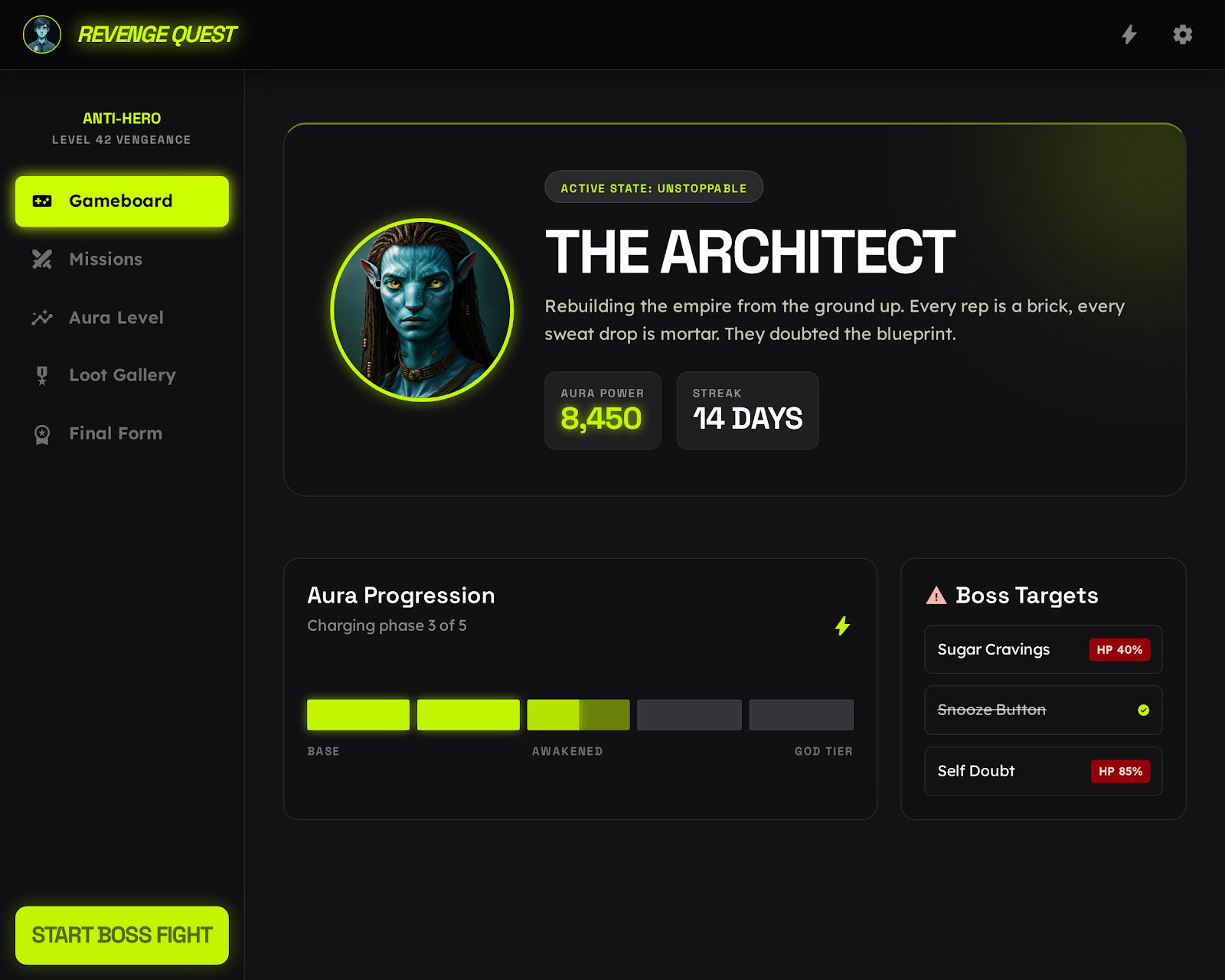
Demo
PROTOTYPE2026-04-24-p004
Revenge Body Quest
A dramatic comeback tracker that turns post-breakup or post-humiliation self-improvement into streaks, boss fights, and shareable aura milestones.
Build Notes
demostitchvanilla-html
Spec Notes
assumptions.md
# Assumptions (KNOWN / ASSUMPTION / UNKNOWN)

## KNOWN
- Transformation fantasies are highly shareable when they feel visual, game-like, and emotionally legible.
- Users already narrate comebacks through photos, gym logs, playlists, and social posts.

## ASSUMPTION
- A theatrical quest format will create stronger repeat use than a generic habit tracker.
- Users will enjoy reframing setbacks as boss fights instead of productivity failures.

## UNKNOWN
- Whether users prefer private self-mythology or public shareable artifacts.
- How quickly the concept needs novelty updates to avoid feeling gimmicky.

## Context tags
- Theme: 역전
- Design profile: playful-experimental
falsification.md
# Falsification checklist — Revenge Body Quest

1. If users want serious coaching instead of playful dramatization, the concept may feel shallow.
2. If the comeback fantasy is fun to look at but weak for daily use, retention will collapse after the first session.
3. If the gamified language becomes cringe for the target audience, sharing will die.
4. If progress signals are too subjective, the aura system will feel fake.
5. If the concept attracts curiosity but not habit formation, monetization paths will stay weak.
6. If users mainly want community validation, a solo dashboard may underdeliver.

## Context
- Theme: 역전
- Design profile: playful-experimental
prd.md
# PRD — Revenge Body Quest

## Problem
- A dramatic comeback tracker that turns post-breakup or post-humiliation self-improvement into streaks, boss fights, and shareable aura milestones.
- Self-improvement tools are usually earnest and bland, which makes users drop off when what they really want is drama, momentum, and a visible sense of comeback.

## Target user
- Young adults who want a visually satisfying way to rebuild confidence after rejection, embarrassment, or a rough life slump.

## Constraints
- Time: Users should understand the top action path in under 5 minutes.
- Budget: The first version should work with manual input, lightweight imports, and no deep enterprise integrations.
- Platform: Desktop-first planning product designed for a single high-focus session.

## Non-goals
- Full back-office system replacement.
- Heavy automation that requires hidden AI decisions.
- Multi-role admin tooling beyond the core operator or end-user workflow.

## Success metrics
- Users can understand risk, upside, or emotional momentum in one screen.
- Users can identify the next action without reading a long manual.
- The interface makes the human driver of the product feel obvious rather than abstract.

## Notes
- Theme: 역전.
- Design profile: playful-experimental.
- Core UI sections: comeback identity card, aura level timeline, mission streak board, boss-fight obstacle panel, confidence loot gallery, final form recap drawer.
qa-checklist.md
# QA checklist — Revenge Body Quest

## Happy path
- User can define a comeback goal and immediately see a quest-style progress frame.
- Streaks, milestones, and obstacle panels feel visually connected in one screen.
- Recap content reads like a real payoff, not placeholder hype.

## Edge cases
- Users with only one active mission still get a satisfying board.
- Long gaps in progress do not break the emotional tone or layout.

## Acceptance verification
- Theme is labeled as 역전.
- Design profile is labeled as playful-experimental.
- Required UI sections are present in the written spec and ready for Stitch export handoff.