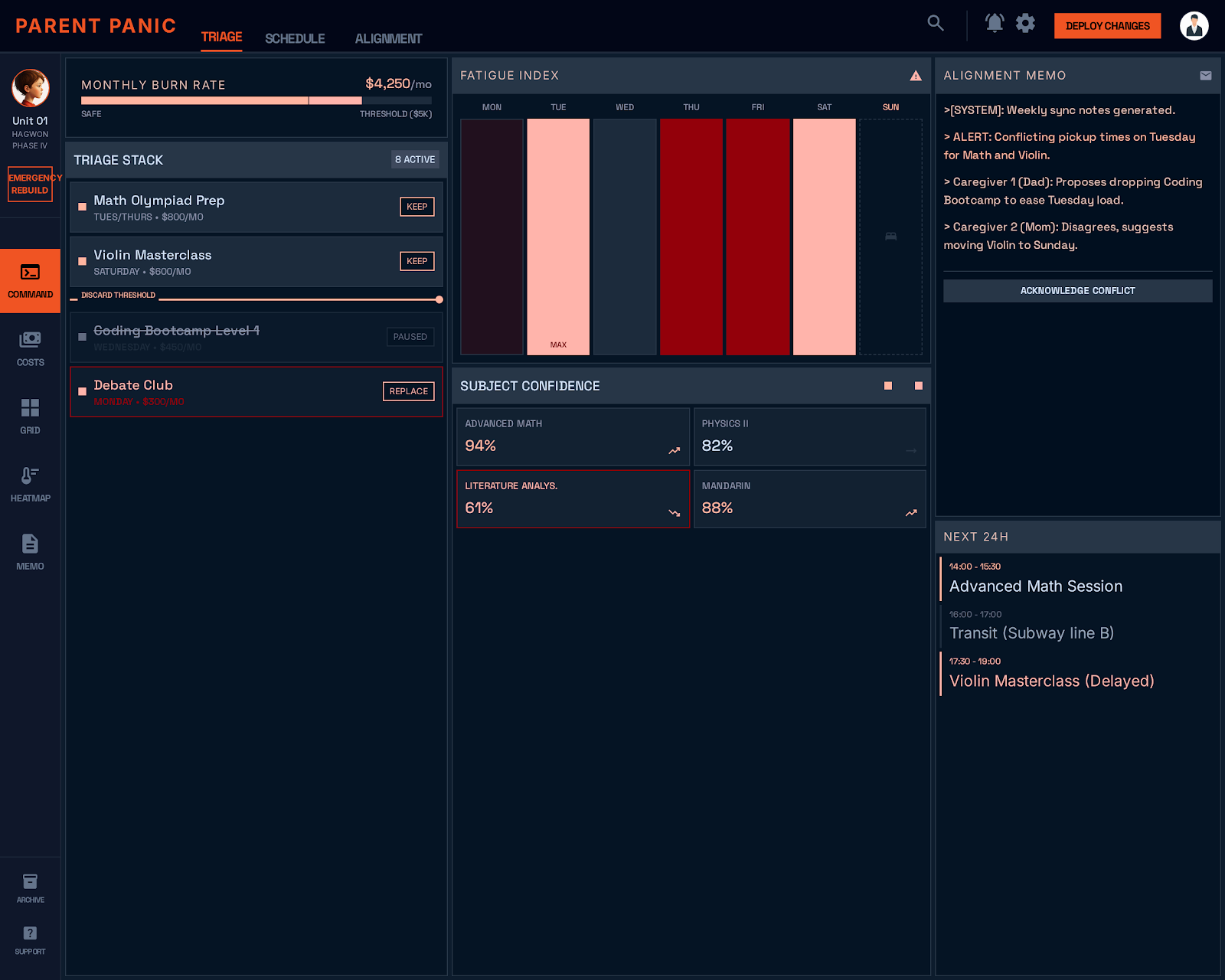
Demo
PROTOTYPE2026-04-24-p003
Parent Panic Cutline
A private education triage board that helps parents decide which classes to keep, pause, or replace when monthly hagwon costs are rising faster than confidence scores.
Build Notes
demostitchvanilla-html
Spec Notes
assumptions.md
# Assumptions (KNOWN / ASSUMPTION / UNKNOWN)

## KNOWN
- Private education decisions are tied to fear, status pressure, and household budget strain.
- Parents already juggle fee notices, timetables, and perceived performance signals manually.

## ASSUMPTION
- A keep-pause-replace workflow will feel safer than forcing an all-or-nothing cut.
- Caregivers will value a shared memo trail when explaining why one class stays and another goes.

## UNKNOWN
- How much measurable score data families actually have versus gut feel.
- Whether the same planning structure works across elementary, middle, and high school contexts.

## Context tags
- Theme: 사교육
- Design profile: operator-dense
falsification.md
# Falsification checklist — Parent Panic Cutline

1. If parents almost never cut classes once enrolled, the board may not change behavior.
2. If fatigue and confidence are too subjective to compare, the core matrix will feel arbitrary.
3. If households mainly want tutor discovery rather than triage, the product is mispositioned.
4. If the weekly rebuild takes too long, usage will collapse into emergency-only sessions.
5. If caregiver disagreements dominate the workflow, single-screen planning may be insufficient.
6. If perceived academic payoff is impossible to summarize simply, trust will erode.

## Context
- Theme: 사교육
- Design profile: operator-dense
prd.md
# PRD — Parent Panic Cutline

## Problem
- A private education triage board that helps parents decide which classes to keep, pause, or replace when monthly hagwon costs are rising faster than confidence scores.
- Parents often buy more classes to reduce guilt, but the result is higher spend, higher child fatigue, and less clarity about what is actually working.

## Target user
- Parents managing multiple hagwon, tutor, worksheet, and test-prep bills who feel guilty cutting anything even when the family budget is tightening.

## Constraints
- Time: Users should understand the top action path in under 5 minutes.
- Budget: The first version should work with manual input, lightweight imports, and no deep enterprise integrations.
- Platform: Desktop-first planning product designed for a single high-focus session.

## Non-goals
- Full back-office system replacement.
- Heavy automation that requires hidden AI decisions.
- Multi-role admin tooling beyond the core operator or end-user workflow.

## Success metrics
- Users can understand risk, upside, or emotional momentum in one screen.
- Users can identify the next action without reading a long manual.
- The interface makes the human driver of the product feel obvious rather than abstract.

## Notes
- Theme: 사교육.
- Design profile: operator-dense.
- Core UI sections: monthly tuition burn meter, subject confidence grid, child fatigue heatmap, keep-pause-replace command board, weekly schedule rebuilder, caregiver alignment memo drawer.
qa-checklist.md
# QA checklist — Parent Panic Cutline

## Happy path
- User can input multiple classes and immediately see total spend and fatigue pressure.
- Keep, pause, and replace actions update the weekly schedule clearly.
- Decision notes explain the tradeoff without placeholder text.

## Edge cases
- Sparse data still preserves a useful board state and readable hierarchy.
- High-cost months still keep one clear next action visible.

## Acceptance verification
- Theme is labeled as 사교육.
- Design profile is labeled as operator-dense.
- Required UI sections are present in the written spec and ready for Stitch export handoff.